Why Your Sleep Schedule Affects Your Houseplants More Than You Think
Disclosure / Affiliate Notice:
As an Amazon Associate I earn from qualifying purchases. Some links in this article may be affiliate links that earn me a commission at no extra cost to you.
The idea that your sleep schedule could be silently sabotaging your houseplants might sound far-fetched, but I’ve witnessed this phenomenon countless times in my years of helping people troubleshoot their indoor gardening failures. Most plant owners focus obsessively on soil types and fertilizer schedules while completely overlooking how their own erratic lifestyle patterns create chaos for their green companions.
Here’s what I find most fascinating: plants are creatures of habit in ways that put even the most routine-oriented humans to shame. They’ve evolved over millions of years to expect predictable patterns—sunrise, sunset, seasonal changes, and consistent moisture cycles. When we disrupt these expectations with our modern, irregular lifestyles, we’re essentially asking plants to adapt to conditions they were never designed to handle.
The Watering Chaos Most People Create
In my experience, inconsistent watering kills more houseplants than any other single factor, and sleep patterns are the hidden culprit behind this inconsistency. I’ve seen people meticulously research the perfect watering schedule for their plants, only to completely abandon it because their daily routine shifts like sand.
Consider what happens when someone decides to become a night owl after months of early mornings. Their carefully established Tuesday-and-Friday watering routine suddenly becomes Tuesday-and-whenever-I-remember. Plants don’t just need water—they need predictable water. A rubber tree that has adapted its root activity to expect moisture every 72 hours will begin showing stress symptoms when that interval stretches to 96 hours one week and shrinks to 48 hours the next.
What most people overlook is that plants prepare for water. They adjust their cellular processes, open their stomata, and position their root hairs based on anticipated moisture. When we disrupt this preparation cycle, we force plants into a constant state of biological confusion. It’s like repeatedly changing someone’s meal times without warning—eventually, their digestive system stops functioning optimally.
Why Your Late-Night Netflix Habits Hurt Your Plants
The lighting situation in most homes creates a perfect storm of plant stress, and it’s entirely driven by human sleep patterns. People who stay up until 2 AM scrolling through their phones are inadvertently subjecting their plants to extended artificial light exposure that disrupts natural photoperiod cycles.
I’ve observed that tropical houseplants, which make up the majority of popular indoor varieties, are particularly sensitive to this disruption. These plants evolved in environments with consistent 12-hour day-night cycles. When we keep our living room lights blazing until midnight one day and turn them off at 9 PM the next, we’re creating the botanical equivalent of chronic jet lag.
The reverse problem affects people who sleep in frequently. Plants positioned near bedroom windows miss crucial morning light when blackout curtains stay closed until noon. This delayed light exposure doesn’t just affect photosynthesis—it shifts the plant’s entire metabolic schedule, affecting nutrient uptake, growth hormone production, and even pest resistance.

Temperature Chaos and Plant Stress
Here’s something that surprises most plant owners: the temperature preferences that help humans sleep better often create miserable conditions for plants. Night shift workers who keep their homes cool during the day and warm at night are essentially forcing their plants to live in an inverted climate that goes against millions of years of evolution.
Plants expect cooler nights and warmer days because this pattern drives crucial physiological processes. Nighttime cooling allows plants to conserve energy and process the nutrients they’ve absorbed during the day. When we flip this pattern to accommodate our own comfort, we disrupt these fundamental biological processes.
I’ve noticed that people with erratic sleep schedules also tend to miss the subtle environmental cues that indicate when plants need protection from temperature extremes. Someone with a consistent morning routine will notice when their plants need to be moved away from cold windows or closer to heat sources. Erratic sleepers often miss these changes until their plants are already showing obvious stress symptoms.
The Pest Detection Problem
This might be the most overlooked connection between sleep patterns and plant health: pest detection requires consistent observation under similar conditions. Spider mites, aphids, and scale insects are masters of stealth multiplication, but they’re easiest to spot during their early stages when populations are still manageable.
People with regular morning routines develop an intuitive sense for their plants’ normal appearance under consistent lighting conditions. They notice when a leaf looks slightly different or when there’s an unusual shimmer that might indicate spider mite webbing. Someone checking their plants at random times under varying light conditions will miss these subtle early warning signs.
The timing of pest treatments also matters more than most people realize. Many effective organic treatments work best when applied during specific parts of the plant’s daily cycle, typically in the early morning or late evening when stomata are most active.
Air Quality and the Sleep Connection
Here’s where the relationship between human sleep and plant health gets really interesting: poor sleep quality affects breathing patterns, which influences air circulation around plants. I’ve observed that people who sleep poorly tend to create more air movement through restless activity, while sound sleepers create more stagnant air conditions.
Plants in bedrooms experience the most direct effects from these sleep-related air quality changes. Tropical plants like peace lilies and Boston ferns are particularly sensitive to air circulation patterns. Too little air movement can lead to fungal problems, while too much can cause excessive moisture loss.

The humidity factor adds another layer of complexity. Many people run humidifiers or dehumidifiers in their bedrooms to improve sleep comfort, often without considering how these devices affect nearby plants. I’ve seen people create perfect growing conditions for mold and fungus by running humidifiers all night near moisture-sensitive plants.
Who This Really Matters For
This sleep-plant connection is most critical for people who struggle with houseplants despite following all the traditional care advice. If you’re someone who has killed multiple plants while swearing you followed the watering schedule religiously, your irregular sleep patterns might be the missing piece of the puzzle.
This information is also valuable for anyone going through major life changes that disrupt sleep patterns—new jobs, relationship changes, health issues, or even positive changes like having a baby. These are exactly the times when people notice their plants declining and can’t figure out why.
On the other hand, if you’re someone with naturally consistent daily routines, you probably don’t need to worry much about this connection. You’re likely already providing the stable environment that plants crave without even realizing it.
The Bigger Picture
What fascinates me most about this sleep-plant relationship is how it reveals the interconnectedness of our living environments. We tend to think of plant care as a separate activity from our personal health and lifestyle choices, but they’re actually deeply intertwined systems that influence each other in subtle but significant ways.
The people who seem to have a natural “green thumb” aren’t necessarily more knowledgeable about plants—they’re often just more consistent in their daily routines. This consistency creates the stable environmental conditions that allow plants to thrive, while inconsistency creates stress that manifests in all the familiar symptoms of plant decline.
Understanding this connection doesn’t mean you need to become a slave to rigid schedules. Instead, it means recognizing when your lifestyle changes might affect your plants and adjusting your care routine accordingly. If you know you’re entering a period of irregular sleep, you can compensate by setting up more automated watering systems or moving plants to more stable locations.
The real insight here is that successful plant care isn’t just about following rules—it’s about creating consistent environments that allow plants to establish their natural rhythms. When we align our care routines with both plant needs and our own sustainable lifestyle patterns, we create conditions where both humans and plants can thrive together.
For plant owners dealing with irregular schedules, automated watering systems can help maintain the consistency that plants need regardless of daily routine changes. Simple tools like self-watering devices can bridge the gap between human lifestyle variations and plant care requirements. A practical example can be found here:
As an Amazon Associate I earn from qualifying purchases.
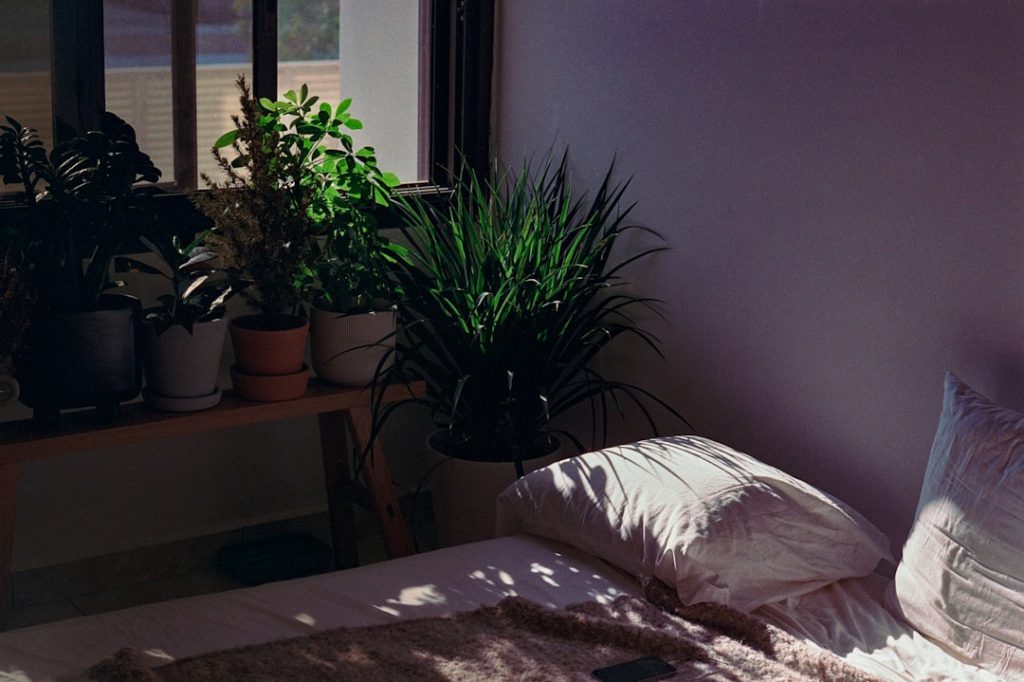
Photo by Joana Abreu on Unsplash
Photo by Theodor Sykes on Unsplash